Oct 7, 20206 min read


The roles of Scrum Master, Project Manager, and Product Owner, although seemingly similar, have many significant differences. In this article, we will describe each of these specialties, list the most important differences between them, and help you decide which of them will best suit your project. Check and find out who you need in your team!
Job descriptions
Before we discuss the differences between these professions, let's talk about each one briefly.
Who is Project Manager?
A Project Manager is a person responsible for the proper implementation and delivering the project on time. His main task is to ensure that the results achieved meet quality requirements and customer expectations. He uses his skills and knowledge to manage the team to achieve clearly defined goals. It is up to him to make every decision related to the project from its initiation to successful implementation. However, in the real world, his responsibilities include much more than just project management.
The Project Manager manages and works closely with the development team, so he is usually required to have a technical background and knowledge.
Who is a Scrum Master?
Scrum Master plays an essential role in every Scrum project. His primary responsibility is implementing the Scrum approach and ensure that it is realized according to the set of rules published in the current version of the official Scrum Guide. Therefore, the Scrum Master needs to make sure that all people in the project understand what Scrum is and what it is about.
Scrum Master, unlike a Project Manager, does not manage a team. Scrum Master is called "a silent leader" - an observer who does not make any critical decisions in the project but works with the team.
The three main areas of his work are related to:
- supporting the Product Owner
- supporting the development team
- organization support
Who is the Product Owner?
A Product Owner is a person responsible for planning and prioritizing tasks for the Scrum teams. He is responsible for the scope of work adopted for implementation and oversees their realization. In his daily work, he has to work with internal and external stakeholders to create the best product plan.
To do this, he must interview customers and then work with the management to establish a final product vision. He is responsible for the final shape and quality of the product, so his work should focus on analyzing opinions about products and staying up-to-date with the latest market trends.
Key skills
As you can guess, each of these professions requires high interpersonal skills and technical knowledge. That's why below, we have focused on the most critical skills needed in the work of Project Manager, Scrum Master, and Product Owner.
Key Project Manager skills
Leadership
It is an essential competence of the Project Manager. The project team members expect a particular vision and style of project management. Therefore, the Project Manager should be perceived by co-workers as an authority. It is especially important in case of problems, the necessity to make changes in the project, or uncertainty about further operations.
Time management
The Project Manager should also have excellent organizational skills. His work requires proper time management because it is an integral part of the whole project's success. Project Manager monitors whether the team will be able to deliver their project on time. His responsibilities include managing the project schedule and ensuring that no part of the process takes longer than it should. It is worth noting that the Project Manager manages his own time and helps other team members achieve their tasks to do their work as efficiently as possible.
Negotiation
Another essential skill of the Project Manager is strong negotiation skills. Thanks to them, he will be able to create a project by the defined plan and vision. Therefore, he must negotiate effectively with representatives of various groups, such as clients, users, teams, Project Board, or suppliers.
Risk Management
Projects do not always go according to plan from start to finish. Therefore, the Project Manager should be ready for any potential problems related to project development and be able to risk management. He needs the ability to identify, manage, and deal with risk effectively.
Key Scrum Master skills
Strong Scrum and Agile knowledge
First of all, Scrum Master must have a vast knowledge of Agile Methodology and work in the Scrum team. This is extremely important because he must pass on his knowledge and teach the other team members all the best practices used in Scrum.
Communication skills
His job also requires high interpersonal skills, excellent communication abilities, and a lot of patience. For example, if a team member does not understand why he is asked to do something, Scrum Master must explain his task's importance in the product development process.
Servant Leadership
In Scrum Master's work, leadership qualities are also essential to set achievable goals for individual team members. Therefore, the Scrum Master should be perfectly organized and have an established process of supervising each Scrum team. Moreover, he must be able to motivate people to listen to his advice and make that they will work as effectively as possible. Finally, he should also have a strong personality and be able to convince people of his ideas.
Key Product Owner skills
Multi-disciplinary skills
In the Product Manager's work, a wide range of skills is required because a good Project Owner should combine the qualities of a marketer, engineer, and technical advisor. He should have both technical knowledge and extensive soft skills.
Communication and negotiation skills
He works closely with the development team, and he also represents his team in discussions with other company departments. Therefore, he must have developed communication skills that will help him to negotiate and find a balance between the conflicting interests of the different departments of the company.
Decision
Product Owner should also be determined and confident in making important decisions. He often makes key choices, so he must have a clear vision and consistently create the best possible product.
Marketer skills
And why does the Product Owner need the mentioned above marketer skills? Well, in his work, contact with the customer also plays an important role. He is responsible for building customer relations, which can ensure the success of the whole product in the long run.
Project Manager vs. Scrum Master vs. Product Owner - responsibilities
Project Manager Responsibilities
- Managing the project organization
- Management quality of the developed software
- Monitoring and measuring project progress
- Project risk management
- Team management
- Planning and managing a business case
- Approval and management of project changes related to the scope of work, time, and budget
- Creating project plans, such as project initiation documents, Gantt charts, and many others
- Providing administrative services for the project
Scrum Master responsibilities
- Leading and coaching the team in implementing Scrum and following its principles
- Planning of Scrum implementations in the organization
- Helping the team understand Scrum and empirically develop products
- Implementing changes to increase the productivity of the Scrum team
- Cooperation with other Scrum Masters to increase the effectiveness of using Scrum in the organization
Product Owner responsibilities
- Maximizing the value of the product for users, customers, and the organization
- Taking care of the highest product quality
- Providing and unifying a direction to the product
- Providing the resources for the product
- Authorizing the funds or the product
- Providing visible support for the product
Project Manager, Scrum Master, Product Owner - how should they collaborate?
As you can see, the responsibilities of Project Manager, Scrum Master, and Product Owner are significantly different and cannot be performed by one person. What's more, they should work closely together to get the best results for the business. So, how should they collaborate, and where do their areas of work intermingle?
Understand customers and business needs
First of all, the whole team's common task should be to create a top-quality product that meets the expectations of customers or users. To make this possible, you need a Project Manager who will adequately manage the development team, Scrum Master, that will motivate team members and the Product Owner to make sure the product is of the best quality and meets the expectations of all project stakeholders. This is why Project Manager, Scrum Master, and Product Owner should work together to achieve the best possible according to market needs.
The product roadmap and a product vision
To create a clear vision of the product and then the whole roadmap of the team's activities, close cooperation between the Project Manager, Scrum Master, and Project Owner is highly needed. They should not only try to deliver a quality product on time but also to determine a clear action plan to which all team members will follow. The Project Manager and Scrum Master should support the Product Owner in defending the final vision of the product and strive to achieve it.
Timeliness
Although this is primarily the task of the Project Manager, Scrum Master and Product Owner should also focus on delivering the project on time. Scrum Master can help by motivating the team and prioritizing tasks, and Product Owner - for taking care of the product direction aligns with its original vision.
Motivating the team
Motivating team members is mainly a task for the Scrum Master, but not only. In this case, the support of the Project Manager and his strong leadership skills will be useful. Their joint effort can contribute to the team's sufficient work, in which everyone feels an integral part of the project.
Prioritization of tasks and watching over the progress of work
To make work in the Scrum team effective, making regular meetings are necessary. During those meetings, the team members set priorities for the near future to know what they need to focus on. Conducting such a meeting is a task for the Scrum Master, but he should not make decisions without prior arrangements with the OP and PM and jointly define priorities for the project in line with the product vision.
Project Manager vs Scrum Master vs Product Owner - summary
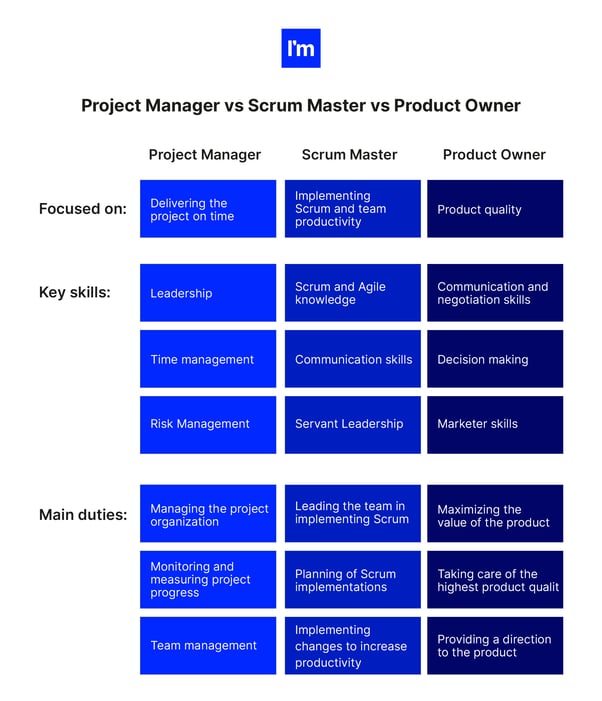
To better illustrate the differences between Project Manager, Scrum Master, and Product Owner, we have collected all the most important information in the table below.
As you can see, the daily work and responsibilities of a Project Manager, Product Owner, and Scrum Master, although they are interrelated in some areas, require different knowledge and skills. Each of these people plays an important role in the team, so it's not possible to answer explicitly which one you need most. Ideally, your team should have all of these people. But if you have to choose, analyze what skills are most needed in your digital project to achieve the best business results. Good luck!
Are you looking for someone to manage your digital product? Our network of Product Managers, Product Owners and Scrum Masters is ready to support you, fit for your industry, technology, company culture, and business needs. Moreover, we also deploy fully operational software development teams perfectly fitted for your project.
Jarosław is an IT Project Manager at Ideamotive. Agile enthusiast with master experience on working with technical teams.
View all author posts
Trending articles
21 Dazzling Examples of Mobile App UI Design to Inspire You in 2023
Michał Pruciak 7 min read
MedTech vs HealthTech vs BioTech: What Are The Differences?
Michał Pruciak 7 min read
10 Business Applications of Neural Network (With Examples!)
Michał Pruciak 4 min read
10 Irresistible Examples of Web Design Best Practices for 2023
Adam Kozłowski 7 min read
28 Amazing Examples Of PHP Web Development
Dawid Karczewski 14 min read



Looking for a specific type of business support service?
Looking for IT project managers to join your team?
There are dozens of vetted IT project managers in our talent network.