Jan 5, 20228 min read


Microservices enabled software designers and developers to achieve more in-depth software versatility and higher performance through a well-segmented approach. Specialists today use Python to split an application’s frontend and backend so that both parts can be developed, tweaked, and optimized separately. This ultimately results in cleaner code, new business organization opportunities, and pinpointed performance boosts.
However, there are underlying nuances and challenges, too. Like the need for two separate teams of specialists working on the split parts of the app; your initial need or lack thereof to adopt the Python microservices approach; and related dedicated talent recruitment efforts. In the light of all the benefits one gets when the approach is introduced to a fitting project, these may as well be the challenges you may want to take your time to overcome. Because in the long run, something truly unique can be built. Learn more in the full article.
Building a Microservice in Python: Business Guide
Service-oriented architectures came about as a streamlined alternative to monolithic solutions that were gradually going out of date. The concept of building more advanced yet easier-to-maintain software structures “brick by brick” introduced flexible architectures based on microservices. Solutions that consist of numerous underlying services that enable different technical and business features.
Assembled in a custom order, so-called microservices help form software architectures that are far more versatile and tailored than solutions built as one whole app. In many cases, such architectures allow companies and entrepreneurs to avoid tons of cumbersome monolithic software development and management headaches.
At the same time, the industry giants that rely heavily on mobile and web software, like Amazon, Netflix, Uber, Etsy, and others, have been opting for microservice architecture to achieve a more extensive app functionality through more complex solutions. And Python seems to be the leading technology behind this approach.
What are microservices in Python, how are they built, and does your specific project truly need them? Let’s try to figure this out by exploring the topic.
Building Microservices in Python: What Does it Take?
Consider a few tech details first, just to get a big picture of what we are talking about.
In a bit more technical terms, microservices form a software architecture style where separate programs responsible for individual tasks are interconnected to achieve a wholesome structure. At that, you can either build a new application from scratch by this principle or take an existing app and break it up into smaller parts via Python.
The microservice approach can be selected for various purposes, but right off the bat, you get a project architecture that’s easier to scale along with the growth of traffic and an opportunity to conveniently work on separate parts of the project after the separation of concerns.
Savvy Python engineers may use a number of underlying models and tools to build a general framework that would support critical applications (i.e., microservices). Flask, Docker, and Django are the most popular picks. But what exact responsibilities can microservices handle? Suppose, we have a big online store of, say, sports equipment. A monolithic platform can be broken down into the following separate services:
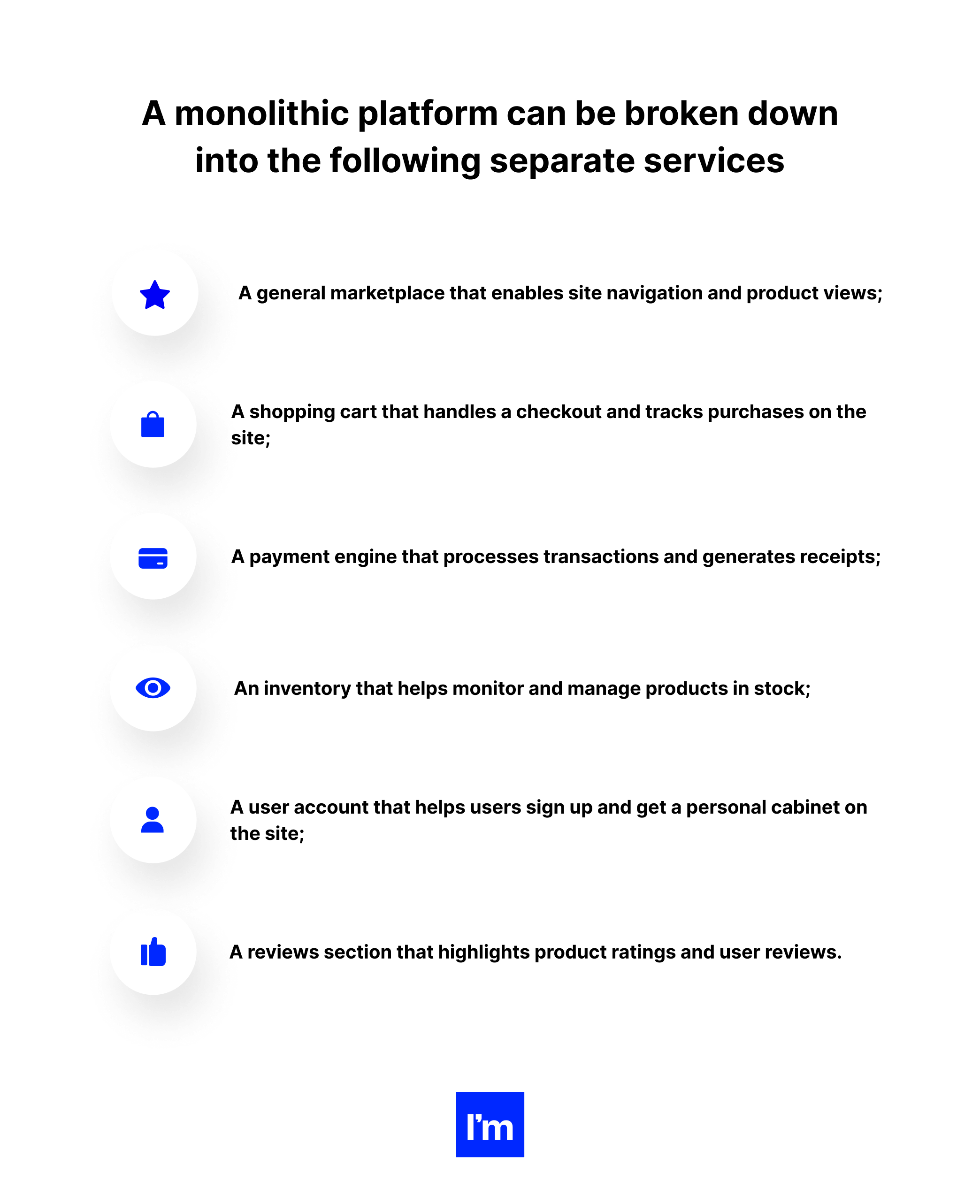
Let’s take this structure as an example. The great thing here is that each of these services may have a relatively independent logic developed and maintained by separate teams of specialists. This opens vast optimization and gradual expansion capacities. And if one service is buggy, others won’t be affected.
When it comes to the underlying resources for Python microservices development, you can see that you may have to involve several dedicated specialists or even teams in the project. Each is responsible for a microservice or two. For product owners, the level of overall project involvement is usually moderate. However, some intense management is required, which spawns a serious task for a Project Manager. You may as well need a bunch of PMs to manage all the teams, but not necessarily.
On top of that, tinkering with microservices can be quite time-consuming - twice as much as traditional monolithic development usually is. The same goes for costs - extra expenses are generated by the need for constant active communication between teams, heavy management, and competitive rates of highly demanded today Python code specialists. Software services themselves will need to communicate with each other, making remote calls that multiply network latency expenses.
The initial project complexity, however, is a reasonable sacrifice for getting long-term results. Yes, it takes longer to build a segmented solution, and it costs more, but the finished product will be more stable and easily maintainable in the future. However, keep in mind, that all the related time- and cost-efficiency depends on the size and qualification of your development team.
When to Best Use Microservices?
Adopting a Python microservices project structure is a complex decision, and it certainly isn’t a one-size-fits-all approach. We can safely say that if a fast project kick-off and rapid time-to-market is among your priorities, then it is not your fit. It is, however, if you are looking to build (or optimize) an extensive solution with many moving parts. And if you are ready for a significant investment only to turn those headstart expenses into more profits in the future.
You should certainly consider breaking an existing solution down into microservices if you already have a marketplace or some other multi-faceted services solution up and running. This way, you’d take a logical step towards reorganization, decluttering, and eventual optimization of a product on the ground level. For instance, today’s most prominent microservice-based platforms (which we mention a little further below) were originally monolithic and transitioned into a service-driven architecture over time.
But would this development philosophy fit a product built from the ground up in your individual case? To arrive to an ultimate conclusion, try setting in line the following specific first:
- Where does your area of expertise lay? Consider the powers and resources that you can dedicate to the project. For instance, you may have developers that are experienced in creating eCommerce platforms, and they will find working with microservices quite easy. On the other hand, specialists that have only handled simple applications or implemented minor business ideas should work with monolith;
- What is your team structure? Teams of different sizes might be more or less capable of handling the complex mesh of microservices. Ensure that your team has the right capacity and combination of talents necessary to work with a particular type of architecture;
- What are your data storage needs? If you are looking to use a cloud-based data-sharing system, microservices would definitely suit you. It would not work if you have a single database since each service requires independent information storage;
- How ready are you to take increased risks? Although microservices might seem like a more advanced, up-to-date way to run a project or a business, you will find that it’s riskier due to its complexity and high maintenance and testing costs. In this case, one should prioritize control and scaling without being overly ambitious.
Pros and Cons of Microservices in Python
As with any other existing tech concept, Python as a microservices framework brings a lot of advantages to the table, but it also has certain drawbacks on the flip side. Let’s take a look.
Pros
Why would you rather prefer the complex intertwinement of microservices to the simplicity and straightforwardness of monolith architecture? Here are a bunch of reasons:
- Specificity. Each service in a system is custom-tailored for a specific task, providing streamlined organization and agility;
- Flexibility. Since each service can be handled individually, you will find that it’s much easier to change configurations and manipulate the code of your application than it would be with monolith;
- Automatic scaling. Microservices can be increased or decreased in numbers depending on the current load at the separate operation. Although this will only work in certain circumstances, it is an important modification tool;
- Spread functionality. Since you’re eliminating the option of making a mistake in the general code by isolating the different aspects of your program into microservices, it has greater performance and lower downtime. You’re also crossing out the mistakes that you could make when connecting the different services since they’re independent of each other.
Cons
All this might seem like a flawless option for software developers but this type of system is quite specific and far from perfect. A microservice architecture might be significantly more beneficial and less troublesome. Here’s why:
- Communication. For an application to function properly, you will need to establish a reliable connection between all of the services in your program. This process brings about lots of quirks on its own due to the distributed nature of the resulting system;
- Multiple data storages. Independency means that each of microservices must have its own storage context, which will need to be updated with each transaction that comes through;
- Complex testing. Testing will be more costly, as you will have to launch a separate testing process for each of the services in your system. Moreover, each round of testing one block will involve activating all of the other blocks as well, to test their connectivity;
- Deployment. Deploying microservice architectures becomes increasingly complicated as you add more services to a system because each of them will have to be separately monitored, scaled, and coordinated with the others;
- Higher overall costs. All of the reasons listed above mean more work for developers and generally more advanced procedures for testing, deployment, scaling, and maintenance.
You may carefully weigh out all the above info on your own, but we’d strongly recommend letting qualified Python developers assist you.
Types of Microservices in Python
Building Python microservices can be approached from two major angles - a more traditional all-to-all model or the creation of event-driven services. The standard process is your usual research and analysis that results in the requirements, based on which, microservices are implemented according to the planned-out priority.
Alternatively, an event-driven architecture is built on microservices that are triggered by specific events. The “events” are certain updates or changes in the state of some services - for instance, by adding a product to the cart, a customer triggers the follow-up services (notifications, delivery calculations, etc.).
This approach can help you automate many underlying processes and split administrative and consumer services to optimize them separately. However, event-driven architectures may require even more advanced expertise and efforts so you should check your investment capabilities before opting for this robust approach.
Python Microservices - Impact on the Product
All that tech mumbo-jumbo is good and all, but how exactly do the technical capacities of Python code translate to end products - desktop, mobile, and web development applications built on microservices? Felt impact comes on several different levels:
- The product becomes decluttered and cleaner on the programming level, easier to scale and maintain for development and support teams, and smoother and more responsive in terms of the overall performance;
- For the business, this means fewer long-term optimization expenses, increased rates of customer satisfaction and loyalty, and fail-proof operation in the market;
- At the same time, users get a convenient solution focused on helping them resolve issues and achieve goals through tailored functionality.
Talent Pool and Language Popularity
Python developers are generally in high demand, let alone the savviest talents that work with advanced tech and microservices in particular. This is because Python is extremely popular and widely used across so many different areas, from lightweight web apps to data science solutions. So available specialists are certainly not scarce, yet the labor market competition is fierce.
Things become more complicated if we consider that even those decent candidates that you find must be interviewed, picked, and recruited accordingly. And many of them will be filtered out sooner than later. This is why you ultimately shouldn’t miss out on an opportunity to hire Python engineers from an established provider that handles essential recruitment tasks for you.
Is Python Good for Microservices?
As compared to other frameworks and languages, Python makes microservice architecture planning, prototyping, and development much easier and faster. Intense tasks and heavy implementations are streamlined here with the help of Django. At the same time, you get seamless compatibility with legacy (ASP, PHP to name a few), enabling the creation of web service frontends for further hosting of microservices. So is Python really good for microservices? Yes, it definitely is.
Prominent Real-Life Examples of Microservice Architectures
When it comes to Python microservices examples and instances of this development philosophy as a whole, we have nothing but market leaders, it seems.

Amazon’s retail website used to be a very tightly-coupled monolithic structure, which made developers scrupulously untangle dependencies where they needed to scale or upgrade the underlying elements. Amidst all the delays in development, cumbersome interdependencies, and coding challenges, it was decided to split the platform into smaller service-specific applications. For this, the source code was thoroughly analyzed and refactored, making the Buy button, the Shopping Cart, and many other elements into independent services.

Netflix went through similar hurdles before it decided to go for microservices. Only this giant employed cloud capacities to make separate services even more flexible and highly available. And this decision allowed Netflix to scale in line with the times and start handling around two billion API edge requests via almost a thousand loosely-coupled services.

Uber also went for cloud-based services in order to avoid unnecessary software complexity and issues related to REST API connections. In the long run, this enabled the company to scale only where there is a need to scale, update only where there is a need to update, and achieve higher fault tolerance all around.
Wrap Up
Developing a user-oriented solution using Python microservices makes coding hassle-free and seamless thanks to the convenient separation of concerns. It smoothes out business organization with a well-segmented workflow. It helps cut long-term costs and risks through scalability and flexibility. But most importantly - it helps you really get to the core of customer-centric issues and needs, and build solutions based on that.
In the long run, this is more than sufficient compensation for the resources you invest into Python microservice development initially. And all you need to get that compensation is a properly-qualified, reliable specialist by your side.
Let Ideamotive professionals help you hire top-tier Python developers without going far. We can help you plan every step of the way and achieve the most rational allocation of resources. So contact us to discuss your future project and start creating a market-defining solution!
Dawid is a full stack developer experienced in creating Ruby on Rails and React Native apps from naught to implementation. Technological superhero, delivering amazing solutions for our clients and helping them grow.
View all author posts
Trending articles
21 Dazzling Examples of Mobile App UI Design to Inspire You in 2023
Michał Pruciak 7 min read
MedTech vs HealthTech vs BioTech: What Are The Differences?
Michał Pruciak 7 min read
10 Business Applications of Neural Network (With Examples!)
Michał Pruciak 4 min read
10 Irresistible Examples of Web Design Best Practices for 2023
Adam Kozłowski 7 min read
28 Amazing Examples Of PHP Web Development
Dawid Karczewski 14 min read





Looking for a specific type of software development service?
Looking for Python development experts to join your team?
There are dozens of vetted Python professionals in our talent network.